WE DO NOT EXPERIENCE THE WORLD AS IT IS (We Experience It Through What We Learned Early On)

Updated: Jan 8

If change were purely about mindset, most of us would be “done” by now. Because we already know a lot.
We have read the books. We have reflected. We have had the insights.
We can often explain our patterns with impressive clarity.
And yet, in the moments that matter, the same reactions still show up:
we overthink a message
we shut down mid-conversation
we feel a surge of urgency when someone goes quiet
we people-please, withdraw, or try to control the outcome
we promise ourselves we will respond differently next time… and do not
That does not mean we are not trying.It usually means we are working with something older than thought.
In The Developing Mind, Daniel J. Siegel describes a central idea from interpersonal neurobiology: the mind is not shaped in isolation. It is shaped in relationship — through the flow of energy and information within us and between us.
Early connection does not just influence how we feel; it helps organise the developing brain and nervous system.
This is why real change often is not a matter of “trying harder”.
It is a matter of understanding the internal map we are living from — and learning how to update it.
Before we can think, we learn how reality works
From our earliest relationships, something subtle forms.
Not beliefs. Not thoughts. But patterns.
As children, our nervous system learns how the world responds to us. It learns:
what happens when I am distressed
whether someone comes when I reach out
whether my emotions are met, ignored, punished, or too much for the people around me
Before we have language, we are already learning what closeness costs, what emotions lead to, and what we need to do to stay connected.
This is what psychology calls attachment. Many coaching approaches call these internal models.
Different language — same mechanism.
Attachment is also about regulation
We don’t react to the present — we react to what our nervous system expects it will become
A child does not regulate alone.They borrow the nervous system of the adult who cares for them.
When a caregiver responds with presence and sensitivity, the child’s system learns:
“I can be upset and still be safe.”
“My feelings can move through me, and I can return to calm.”
“Connection is available.”
When that response is inconsistent, distant, frightening, or overwhelming, the system adapts in intelligent ways:
“I need to stay alert.”
“I need to manage alone.”
“I should minimise, perform, anticipate, or keep the peace.”
Over time, these experiences are not stored as neat, story-like memories.
Siegel distinguishes between explicit memory (what we can recall and describe) and implicit memory (what we live as emotion, body sensation, expectation, and reflex).
Much of early learning is implicit — which is why we can know we are safe now and still feel braced for impact in certain situations.
Why the same situation feels different to different people?
This is why two people can be in the same situation and have completely different internal experiences.
One person experiences silence as comfort and safety. Another experiences silence as danger.

Neither reaction is random.
Each is shaped by an internal map — a set of expectations built through earlier experiences of closeness, rupture, repair, and emotional response.
Integration: the piece that makes change sustainable
A core theme in The Developing Mind is integration — linking different parts into a more coherent whole.
When integration is present, we tend to feel more flexible and grounded.When it is disrupted, we can swing toward rigidity (stuck patterns) or chaos (overwhelm).
This matters because many of us try to change by placing “better thoughts” on top of a nervous system that is still running old predictions.
But a nervous system does not shift through debate.
It shifts through new experience.
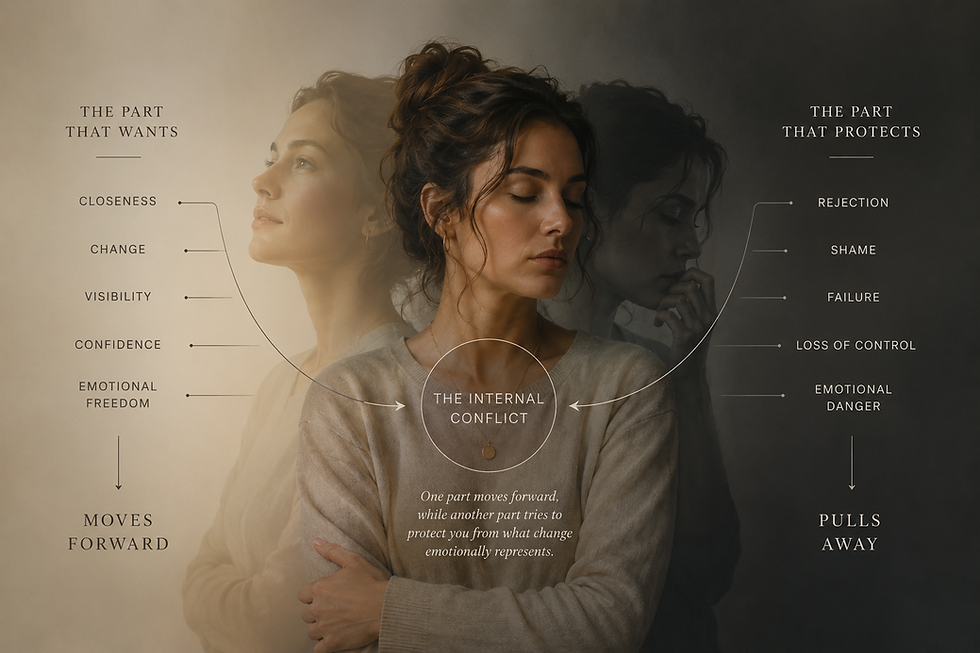
This is one reason transformational life coaching can be so powerful: it is not just insight. It is working with the deeper organisation beneath the insight — the emotional learning, the protective responses, the internal parts that formed to keep us functioning.
In my work, I focus on bringing these internal models into awareness with care — not to fight them, but to understand what they have been trying to do for us, and to create the conditions for something more updated to take root.
Updating the map
Real change begins when these internal models are brought into awareness — gently, safely, without judgement.
Not to erase them, but to update them.
Because what was learned in one context does not have to keep running the present.
A simple place to start is noticing the “rule” that appears in moments of activation:
What is our system predicting right now?
What does it expect will happen if we need something, set a boundary, or get close?
What strategy shows up automatically — pleasing, withdrawing, over-explaining, going numb, staying busy?
Awareness does not fix everything instantly. But it creates a pause, and in that pause, we begin to build choice.